
Making milking more fun for everyone
Healthy cows like to give good milk. Reliable udder hygiene helps you to avoid high cell counts and mastitis – for good milking performance and pure milk quality.
Udder inflammation is painful for the cow and bad for the milk yield. Careful cleaning helps you to combat pathogens and minimise the transmission of diseases amongst your herd.
Udder pre-cleaning, teat disinfection after milking, and the intermediate disinfection of milking tools are essential for optimum hygiene. With our wide range of cleaning and care products, you’re always on the safe side.
FAQ
Udder hygiene and udder protection
Udder hygiene in dairy cows influences milk quality and the health of your herd. You may already be familiar with some of these questions:
Why is interim cluster disinfection useful?
The aim is to break the milking cluster from acting as a germ transmission chain between cows.
Why do experts recommend peracetic acid for intermediate cluster disinfection?
The products used must be fast-acting and leave no residue. As such, STOCKMEIER always recommends products based on peracetic acid, such as Lerasept® Forte.
How do I ensure that my cows are receptive to teat cleaning?
Ideally, cleaning ensures a soft and elastic teat skin, which makes milking easier. Reducing irritation and taking a careful approach makes the cow more receptive to teat cleaning while also stimulating it for the milking process.
What are the most common mastitis pathogens, how do they spread, and what helps to prevent them?
Some spread through cross-contamination during milking or as environmental germs in the barn, e.g. in faeces. Others are part of the natural skin flora of the teats, and only become problematic when the skin’s protective acid layer is disturbed. Cows are particularly at risk during their dry period and the milking process. Good stable hygiene significantly reduces the risk of infection.
How can I prevent mastitis before and after milking?
Cleaning the teats before milking is important, as it removes pathogens that could otherwise enter the udder through the teat canal and cause infections. Cracked teat skin also increases the risk of infection. In addition to this, pathogens can be transferred into the milk and to other animals, which can lead to cross-contamination amongst the herd. After milking, it is essential to disinfect the teats (“teat dipping”), the rubber parts that carry the milk, and the liners.
How do I disinfect properly after milking to keep pests away?
The udder is particularly at risk after milking, as the teat canal takes up to 60 minutes to close. Pathogens can easily get into the teat canal during this time. Dips and sprays that disinfect or form a film as a physical barrier over the canal (barrier dips) are effective forms of protection. Skin care components such as allantoin, glycerine and lanolin are important for protecting the skin during the milking process.
How do I know which active ingredients are most suitable?
There are two types of important product here: disinfection agents and care substances. Depending on the environment, lactic acid, chlorhexidine, iodine or chlorine dioxide may be suitable for disinfection. You can treat the individual teats by spraying or dipping. Allantoin, glycerine and lanolin care for the skin, and should be coordinated with the disinfection agent. Urea, sorbitol and panthenol are more suitable for pure care products. You can find out more about their effect here.
Dipping vs. spraying
Advantages and disadvantages at a glance
| Advantages | Disadvantages | |
|---|---|---|
| Dipping | Ensures thorough coverage of the teat tissue, making it particularly effective in preventing infections. | Can be more time-consuming and requires higher product consumption, especially when dipping by hand. |
| Spraying | Faster and easier to use; ideal for large herds. | May provide less uniform coverage compared to dipping. |
Products
Product overview
| Before milking | For pre-cleaning the udder, we offer udder wash concentrates that are suitable for udder cloth, udder paper or udder showers. We also offer ready-to-use foam products that can also be used in semi-automatic systems. | Leradip® TeatWash Leradip® TeatFoam |
|---|---|---|
| After milking | Our products are based on chlorhexidine and lactic acid, iodine with a high proportion of freely available iodine, or chlorine dioxide as a two-component agent. Our products are available for dipping or spraying. | Leradip® HEXA Film Lerapur® Dip Jod 30 Leradip® OXI Film A + B |
| Intermediate cluster disinfection | Our stabilised peracetic acid products based on 5% and 15% are ideal for disinfecting milking systems. They can be used both manually and with robots. | Lerasept® Forte Lerasept® Spezial |
Dipping agents at a glance
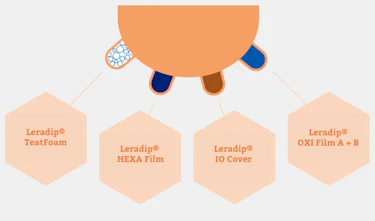
Leradip® TeatFoam
Foaming ready-to-use udder precleaner with caring components.
Leradip® HEXA Film
Chlorhexidine and lactic acid for balanced care and disinfection. With a fresh minty scent.
Leradip® IO Cover
Iodine with barrier film for the best protection
Leradip® OXI Film A + B
Chlorine dioxide for powerful disinfection.
Our products are also available as sprays:
Leradip® HEXA Spray, Leradip® IO Spray 30, Leradip® IO Spray 15, Leradip® OXI Spray A + B
Product selection
- Leracid® RoboACID Leracid® SPN Leracid® 169
- Lerapur® RoboCLEAN Lerapur® CIP-BL Lerades® C-MA ARVO FORCE
- Leradip® TeatWash Leradip® TeatFoam
- Leradip® IO Cover* Leradip® IO Spray 15
- Leradip® HEXA Film Leradip® HEXA Spray Lerapur® Dip Jod 30 INDAL ROBIOSPRAY Leradip® OXI Film A + B Leradip® OXI Spray A + B
- Lerasept® Forte INDAL SUPER MILK Lerasept® Special INDAL PRO ZYM
Our promises
Personal consultation
Optimum milk yield
Focus on animal health
Service & Support
Our experts in Europe

Germany

France

Poland

Global

Germany
France
Poland
Global


